SuperSport, a MultiChoice group of channels, redesigned its flagship Studios 6 production centre ahead of the recent FIFA World Cup held in Russia to provide Africa’s football fans with an exceptional viewing experience.
The FIFA World Cup is widely recognised as the most watched and followed sporting event on the global calendar and is broadcast to every single country and territory on Earth. According to statistics released by research company GlobalWebIndex, approximately 3.4 billion people from around the world watched some part of the recent FIFA World Cup tournament between 14 June and 15 July, which represents almost half of the world’s entire population.
SuperSport, the main broadcast aggregator of sporting content across Africa, understands the enormous following that the FIFA World Cup enjoys – especially after the first African World Cup took South Africa by storm in 2010. In response, SuperSport and the MultiChoice team decided to overhaul the group’s flagship Studio 6 production centre to provide African fans with an exceptional FIFA World Cup 2018 experience.
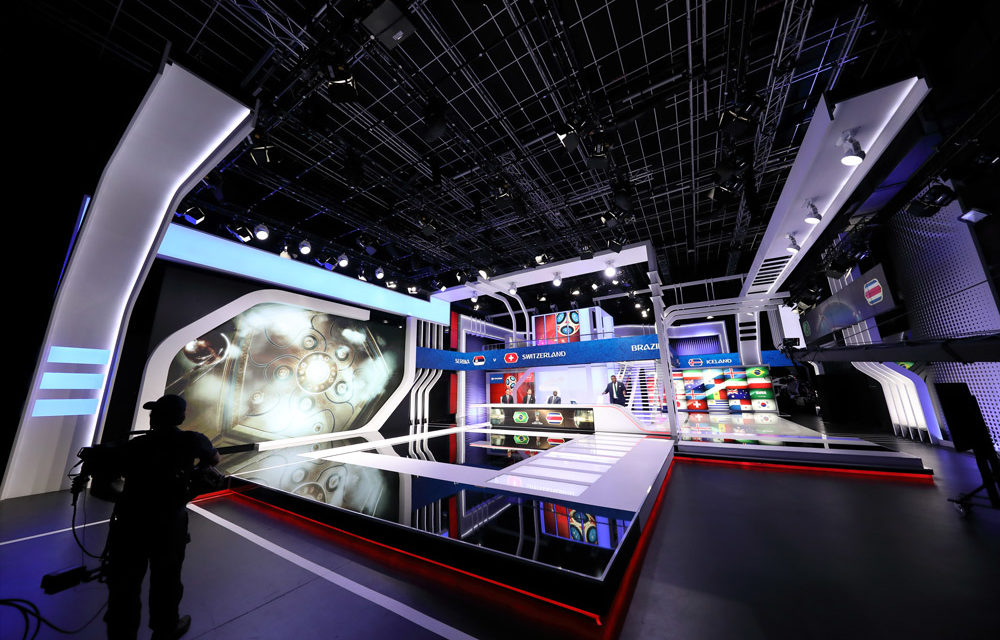
Studio 6 has become one of the largest broadcast spaces at SuperSport and is able to support multiple simultaneous productions. The new double story set for Studio 6, and the Arena includes straight, architectural lines, while interesting nooks and crannies allow producers a diversity of presentation shots. SuperSport has embraced the AV technology revolution with the inclusion of augmented reality production capabilities. Tracking markers have been installed on the roof of Studio 6, and multiple cameras in the studio have been upgraded to support the new AR system.
The new system is a massive upgrade in comparison to the old set. Trussing infrastructure has now been successfully upgraded to safely and reliably support the weight of critical elements of the set.
A Solid Game Plan
Michael Gill, of Michael Gill Designs (MGD), has designed numerous sets for SuperSport in the past, and SuperSport once again turned to Gill to provide a new look and feel for the iconic Studio 6 ahead of the 2018 FIFA World Cup.
Jacques Barnard, vision control and lighting supervisor at SuperSport states that the SuperSport production team supported Gill’s vision for Studio 6 from the start. “We could all see that the new design for Studio 6 was going to be something special. The design aesthetic has moved away from curves and rounded edges, so that the new corporate-looking set has strong, angular lines.” Barnard points out that the set features at least ten different zones or presentation areas, which opens up more creative options for the production team.
“DWR Distribution helped us to effectively increase our overall studio colour temperature during the recent LED upgrade, which finally aligned all our visual elements and we knew the new set would
look beautiful. This time, we utilised DWR to bolster the integrity of our rig and upgrade our whole infrastructure, and we are ecstatic with the results,” Barnard concludes.
Once the SuperSport team had reviewed and accepted Gill’s new design for the SuperSport studios, MGD contracted Gearhouse Group’s set company, Sets Drapes Screens (SDS) to build the new set. The project needed to be completed in three months to ensure that the reveal of the new studios would coincide with the opening ceremony of the FIFA World Cup, held at the Luzhniki Stadium on 14 June.
A Challenging Rig
The implementation of MGD’s ambitious new design for Studio 6 was not without its difficulties. “When we began the process of rebuilding the Studio 6 set, we discovered that the existing rigging was not up to standard. A lot of the set is suspended from the rig, and we had to be certain that everything was constructed according to the required engineering specifications,” Barnard explains. SuperSport turned to DWR for an expedient solution to their rigging challenges.
DWR rigging specialist, Kevin Stannett states that approximately 214 meters of Prolyte trussing was used for the installation. “We dropped all of the existing trussing, had it powder coated black and re-installed using completely new rigging hardware,” Stannett points out. He goes on to explain that the installation included a new cable structure with four DMX tie lines to the Studio 6 control room as well as DMX outlets on the grid and at floor level. Additional dimming in Studio 6 includes five LSC MDR 10-way DMX splitters, and a wireless system enables the studio’s MA Lighting dot2 lighting console to be controlled from a mobile device.
“DWR supplied the foundation from which everything hangs – fixtures and set included,” explains DWR managing director, Duncan Riley.
Bring Up the Lights
Lighting designer Joshua Cutts, who has worked on various projects for SuperSport since 2010, carefully planned a new lighting layout for Studio 6. As SuperSport upgraded their lighting fixtures from tungsten to LED technology a little over a year ago, Cutts had an impressive array of fixtures to work with, including QuartzColor Fresnels; Philips Strand SoftLight 300S TV Panels; Robe Robin DL4S Profiles; Robe Robin Spikies; and Philips Strand Relayrack panels. In addition, SuperSport procured a further five QuartzColor X5 LED Fresnels taking the fixture count to 141 units; six Philips Strand 300S Softlights with barndoors taking the fixture count to 23, and twenty Longman Excelsior 184 RGBW LED Bars.
Reflecting on the project, Cutts states that one of the key objectives of the lighting design for Studio 6 was being sure not to overlight the space, which could result in the set looking flat. As directors experimented with different camera angles in various zones of the studio during rehearsal times, Cutts and his team followed, brightening or darkening the spaces to reach optimal lighting levels. “It is much like sculpting,” remarks Cutts. “The process is slow because, unlike the larger live entertainment shows that we do, in a studio, everything is visible all of the time.”


DIGITAL DISPLAYS DELIVER DIVERSE CONTENT
Controlling the Pixels
Central to Gill’s design for SuperSport’s Studio 6 is an impressive array of LED and LCD monitors, monitor banks, and large-format video walls. To control the video element of the installation, SuperSport called on the services of Richard Baker, Chris Grandin and Mike Tempest from Gearhouse Group to design, install and program the system.
LEDVision, the Group’s LED provider, added to its inventory to supply two Hippotizer Boreals, two Karsts and four FX4s for video control, and worked around the clock to get the system running and programmed in time for the FIFA World Cup. Once the team had completed the design for the system, Mike Tempest was brought in to program and prepare all of the groundwork, and to hand the system over ahead of the 14 June deadline.
Programming the entire set up was a learning curve as both the studio producers and LED operators had to learn how to work the system to get the most compatible outcome. However, Hippo training, presented by Green Hippo’s product specialist Suzy Stenning at DWR Distribution ahead of the launch proved enormously helpful. Dylan Jones from DWR played a supportive role during the implementation of the Green Hippo system at Studio 6.
“The training by Suzy just before the install was crucial to the success of the SuperSport World Cup broadcast,” says Jones. “Working with Mike and Chris on this project has been an incredible learning experience,” he concludes.
“There is a lot Hippotizer Media Servers can do that a lot of other servers can’t,” explains Tempest. “You can operate it manually, which is great because it gives you a randomly accessible mode of operation. When a more advanced look needs to be recalled, you can have a timeline with hundreds of separate keyframes on it, giving you precise control of things which can be animated simultaneously,” Tempest points out.
“Green Hippo is quite an intuitive system to get your head around if you come from a media and server background,” Tempest reflects. “What’s really nice is the way the timeline structure is laid out. You can go in and take a snapshot of whatever is in that timeline as a global event, and all the features get saved there. Alternatively, you can filter it down so that only certain components have a change made or recorded. As with any system, there are a couple of things that could be worked on, but all of these systems are cutting-edge, and in this industry, we always live on the edge,” Tempest concludes.